Introduction
It’s easy to pick on an emerging technology and vilify it. Particularly when everyone is struggling to fully understand it and misinformation is rife.
A decade or so ago it was violent games, social media and mobile devices. Those concerns haven’t completely gone away, but are being somewhat overshadowed by a new emerging technology.
That technology is AI and spin-off products it can power like smart eyewear.
The factors we should really be concerned about can be overlooked by the mainstream media’s clickbait and alarmist reporting based on flimsy to no real research or in-depth expertise.
A consistent concern throughout is overlooking where we are navigating as a society and the kind of unacceptable behaviours we find ourselves being appalled by. If anything, modern technology reveals just how off-track society as a whole has become.
AI Facts vs Misunderstandings
These days when most people use the term ‘AI’ they’re usually referring to Generative AI such as Large Language models (LLM) and image generators. This is one branch of Artificial Intelligence that has completely overshadowed all the other branches that are derived from various forms of machine learning.
Another grave misunderstanding is that LLMs don’t think. They are merely predictive algorithms that predict what word or words typically follow each other in a sentence. It’s like that annoying person you know who’s always guessing the next thing you’re going to say before you actually say it. There were even industry memes running around that joked, “Won’t people figure out it’s just really good auto-correct?”
Natural Language Understanding (NLU) and processing (NLP) have been around for an incredibly long time so this isn’t a completely new technology. The big change however, was the development of transformers that can encode and decode parts of words called tokens. This process allows words to be grouped by type and categories, like animals, vehicles etc. That is how you can ask about a VW and the LLM ‘knows’ you’re talking about a vehicle.
Image generation works slightly differently. It uses tokens from a text encoder to ‘understand’ what you’re asking. It starts with noise and progressively removes the noise until all that’s left is the picture you asked for.
All of these are simplified explanations. The most important point is that these are mathematical operations with non-deterministic outcomes. There is no thinking going on.
The real problems
People are reacting badly to deep fakes and other shady uses of language, audio and image generation. People are also starting to panic because the technology is improving at a rate that it’s increasingly difficult to tell real from fake.
As is so often the case, the common outraged call is to ban it. The really big problem with this, is that the root problem isn’t the tech itself per se. It’s how people are misusing it.
What we should all be deeply concerned about is just how sick huge swathes of society have become. The fact that so many people think it’s okay to manipulate images of real people and depict them in ways that the victim finds derogatory and degrading should be what most concerns us.
This applies across the board to mobile devices, social media and other advances of this ilk. It’s not the technology itself, but the nefarious way many individuals choose to use it.
The hidden problems
The true concerns around this technology are the biases and moral values being baked into various generation models based on their training material. American culture has been largely influencing a lot of the world culture through the power of television over the last fifty years or more.
This influence has been seen in language, spelling and conservative moral values that never should have been unquestioningly adopted, but have been by proxy.
Social media platforms have picked up where television and streaming services have left off. All of these mediums are dictating body image, fashion and social values. Now AI is accelerating this indoctrination at an even faster rate.
Perhaps where this can be seen most notably is in image generation. By default when an image of a person is requested, you are going to get a stereotypical rendition. Even as you refine, the chances of veering off a predetermined path are very low.
How this issue shows up across all forms of media, is a sudden proliferation of highly idealised images representing a narrow band of people. Traditional photographic media went through a slight, ongoing, course correction to portray a more diverse representation of people. Current AI models have a way to go yet.
Current challenges
As things stand, it’s quite difficult to get image generation models to do good representations of anything slightly out of the mainstream. Not only does this marginalise minority groups even further. It also propagates negative body representation by putting even more unrealistic images of people out there based on a stylised ideal.
AI companies and open-source model weight developers attempt to define ethical boundaries and minimise bias. The trouble is, the boundaries, biases and censorships they are defining are all coming from one cultural and ethical perspective.
What are the options?
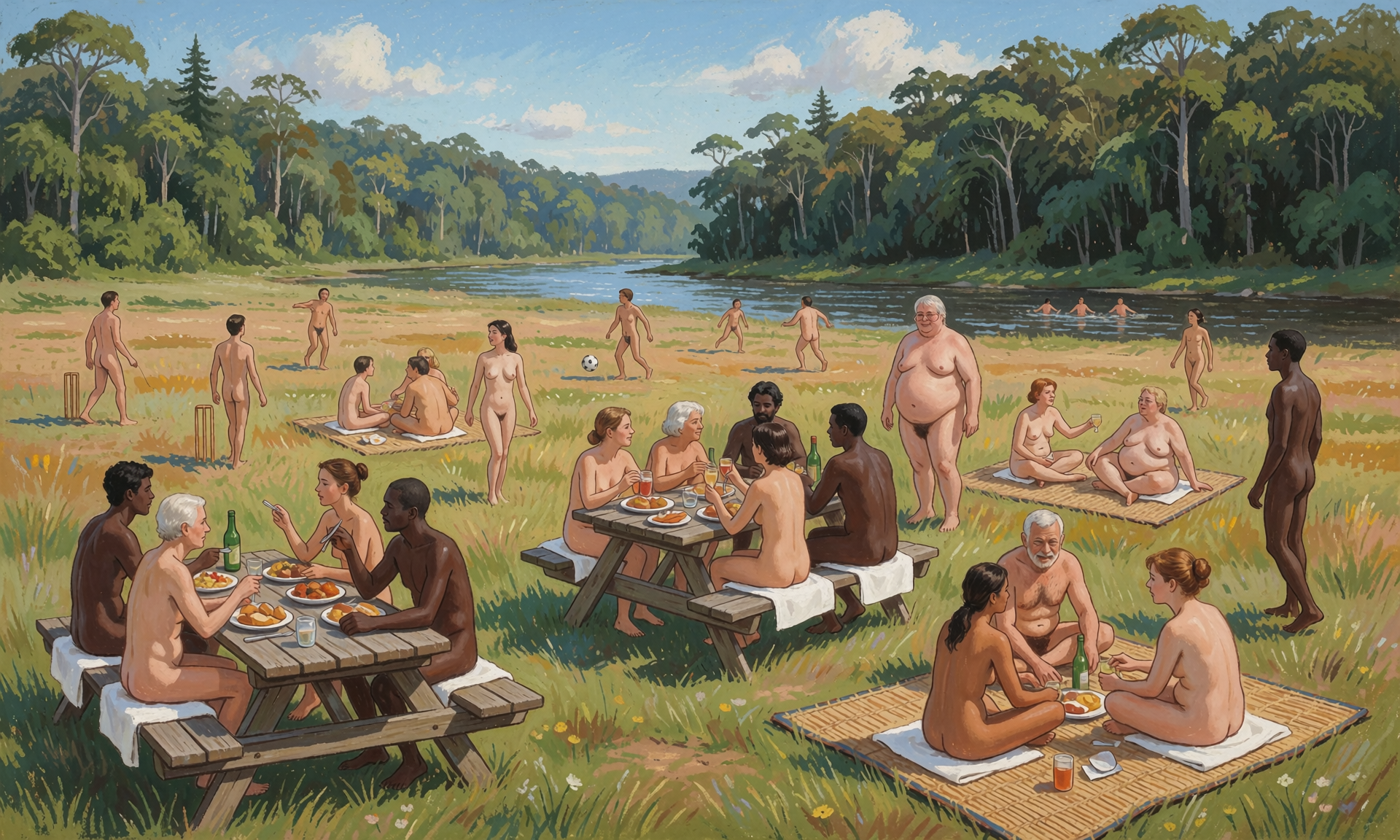
In the very first instance people should be mindful of the images they’re generating and assessing whether these are reasonable representations. For my own part, I’m not going to insert token representations for the sake of it unless trying to illustrate a particular point.
What I do try to attempt is imagery that is reasonably balanced in age and gender, but not go massively overboard in any direction for the sake of trying to cover all bases.
What does concern me are those who are totally unaware of the unbalanced representations they’re publishing. Including the total lack of care.
I do have a problem with the overrepresentation of women depicted in naturist imagery. On certain social platforms people repost images that come from all sorts of questionable, exploitative sources. This type of imagery doesn’t fairly represent the reality of many naturist locations and in many cases, risks creating intimidation due to unrealistic expectations of body image being portrayed.
Conclusion
Banning technology and social media platforms or age-restricting them isn’t the answer. It’s a fast easy band-aid that wins easy votes among the conservative crowd.
Education and improving awareness of the impact and implications of individual behaviour are where our energies should be focussed.
The same old problems and knee-jerk reactions keep repeating themselves because the true issue of mutual respect and social accountability isn’t being addressed.
Meanwhile vast moral divides are ever deepening between the puritan conservative right and the more liberal-minded left trying as ever to improve equality and recognition of diverse minorities.
On the technological front, open-source generative models are at least some antidote to the mega corporation foundation models intentionally sanitised to keep the human body alienated from nature in accordance with the current dogma.
Comments or feedback: Send an email